Every few months, someone shouts that “everything is going to change”.
Then we roll our eyes, grab a coffee, open the Meta Ads Manager or Google Ads, and continue optimizing. Because, well, some hypes blow over. Some trends are mainly good for LinkedIn posts with lots of fire emojis.
But ChatGPT Ads? Conversational Advertising? Now that is one to take seriously.
Not because you need to immediately shift your entire media budget from Google and Meta tomorrow. Certainly not. But because this development may touch upon something that goes much deeper than a new ad format: the way people search for information, compare options, and ultimately make a purchase decision.
In other words: the customer journey is undergoing a major change. And AI is playing an increasingly important role in this.
From searching to asking questions
In the past, and by the past I actually mean: yesterday, much online orientation started with Google.
Someone searched for “best marketing agency Suriname”, “how do I improve my conversion rate”, or “how much does it cost to outsource Google Ads”. Then the familiar dance followed: viewing search results, opening tabs, reading reviews, scanning websites, perhaps filling out a form, and then hopefully becoming a customer someday.
Now something else is happening.
People no longer just type keywords. They ask complete questions.
Which marketing strategy suits a local service provider who wants more leads?
Compare three options for online advertising on a small budget.
What would a good agency do if my campaigns get a lot of clicks but few inquiries?
Do you see the difference?
The user is not just looking for information. They are asking for advice. Context. Consideration. Direction. And that is precisely where conversational advertising becomes interesting.
Because when someone is in the middle of such a conversation, the intention is often clear.
What are ChatGPT Ads actually?

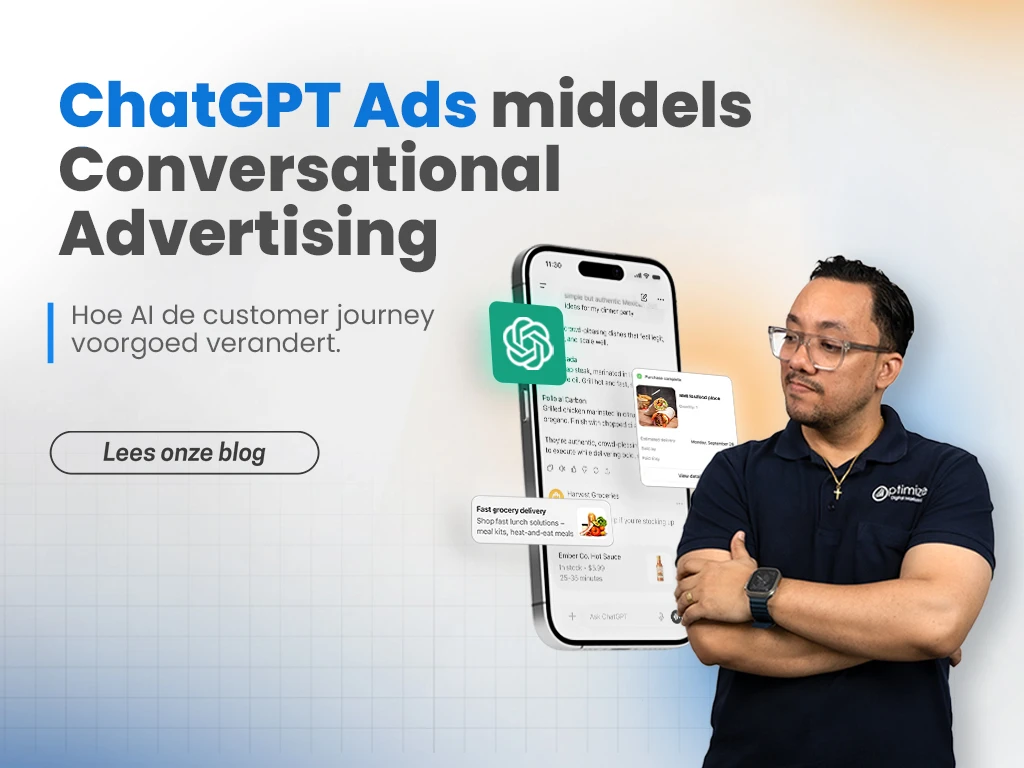
ChatGPT Ads are advertisements that appear within or around an AI conversation. Not as a classic banner at the top of a news site. Not as a pre-roll video that you watch with a sigh for five seconds. But as a sponsored suggestion that aligns with what someone is discussing at that moment.
Imagine this: someone asks ChatGPT how they can improve their online marketing. The AI explains SEO, paid ads, conversion optimization, and content. Below that answer appears a clearly labeled advertisement from an agency that helps with digital growth strategy.
Not random. But relevant. Contextual. In the moment.
That is the core of conversational advertising: advertisements that align with the conversation, the question, and the user's intent.
And yes, that is where the tension lies. Because a conversation with AI feels more personal than a search results page. If an ad feels too intrusive there, you lose the user. One wrong placement and trust takes a hit.
Why this is different from Google Ads
Google Ads has been running on intent for years. Someone searches for something, you bid on a keyword, and your ad appears. Simply put: supply and demand meet.
But ChatGPT and other AI assistants add something to that: dialogue.
A search query is often a single moment. An AI conversation is a series of moments. The user provides context, adds nuance, asks follow-up questions, compares options, and sometimes subtly reveals what is really bothering them.
For example:
“I want more leads.”
But my budget is limited.
We have already tried social media.
Actually, we mainly want customers who can buy immediately.
“What should I do first, then?”
As a marketer, you don't just see a search term here. You see a mini customer journey.
And that is worth its weight in gold.
For while Google Ads often responds to what someone searches for, conversational advertising can tap into how someone thinks. Into doubts. Into preferences. Into timing. Into buying readiness.
That might sound like music to the ears. But it also calls for a mature approach. No flashy ad copy. No empty promises. No “we are the best” without proof.
Additionally, you must accept that data coverage is never fully comprehensive due to privacy legislation (GDPR), cookie banners, and browser restrictions such as Apple's ITP and ad blockers. Although Server-Side Tracking can compensate for some of this data loss, discrepancies will always remain.
The customer journey is becoming less linear
We like to map out the customer journey neatly.
Awareness. Consideration. Conversion. Retention.
Beautiful and well-organized
But in practice, we all know: things rarely go that smoothly.
A potential customer first sees a LinkedIn post, clicks on an advertisement three weeks later, asks ChatGPT for advice, checks out a competitor, reads reviews, forgets everything, returns via Google, and finally fills out a contact form at 23:47 PM on a Tuesday evening.
Welcome to marketing…
With AI, that route becomes even less linear. ChatGPT can bring multiple phases together in a single conversation. Awareness, consideration, and even a bit of decision-making can take place within five minutes.
Someone who starts with “what is conversational advertising?” can end with “which agency can help us with this?”
That is no longer a traditional funnel. It looks more like an accelerated decision-making process in which multiple phases of the customer journey converge in a short period of time.
For marketing agencies, this means we need to think differently about visibility. It is no longer just about ranking in Google or a beautiful meta campaign. It is also about being present in the AI-driven orientation phase.
The question is not just: “Are we at the top?”
But also: “Are we named, understood, and trusted by AI systems?”
Organic and paid are growing closer together

This is where it gets interesting. Because in conversational AI, organic visibility and paid visibility are increasingly overlapping.
If ChatGPT provides an answer regarding “best ways to generate more leads”, your brand can appear in it in various ways:
- as an organic recommendation;
- as a source or example;
- as a sponsored placement;
- or not at all.
You would rather avoid the latter.
Therefore, it is becoming important not only to buy advertisements but also to have your digital foundation in order. AI systems need clear, up-to-date, and reliable content to understand you properly. Think of strong service pages, clear case studies, FAQs, structured content, and consistent brand positioning.
In other words: paid AI advertising without a good content strategy is like a nice car without fuel. You won't get far.
At Optimize Digital Marketing, we therefore look not only at individual channels, but at the bigger picture: how your brand is visibly, convincingly, and measurably present at the moments that matter. Take a look at our services , for example , if you want to see how we combine strategy, content, advertising, and data into an approach that supports sustainable growth.
Why trust becomes all-determining
An advertisement on Instagram can be fast, eye-catching, and a bit bold. People scroll past anyway.
But an advertisement in an AI conversation? That's a whole different story.
For many users, ChatGPT feels like an assistant. A sparring partner. Sometimes even an advisor. If an advertisement suddenly appears, it must be clearly labeled and its content must align with the user's intent.
Otherwise, it doesn't feel like help. Then it feels like manipulation.
And that is exactly what brands need to be careful with.
Conversational advertising only works if the ad feels like a logical continuation of the conversation, not a commercial interruption. Relevance, timing, and tone are therefore becoming more important than ever.
What does this mean for marketing agencies?
For agencies, this is both an opportunity and a warning.
The opportunity: a new channel is emerging where intention can be extremely strong. Not just “someone is looking for something,” but “someone explains exactly what they want to achieve and what they are struggling with.”
The warning: old tricks won't work as well here.
Conversational advertising requires different creative, different targeting, and different measurement methods. You can't just copy your Google Ads headlines and hope it works. The context is different. The user's mindset is different. The expectations are different.
Agencies will have to consider questions such as:
Which conversations are commercially interesting for our clients?
What information does AI need to properly position our client?
Which claims can we substantiate?
Which advertisement feels helpful rather than annoying?
How do we measure impact when the journey no longer runs neatly via a single click?
The latter will be a significant challenge. Attribution is already complex enough today, with customers coming in through multiple channels and touchpoints. Add AI conversations to that, and it becomes even harder to determine exactly which interaction ultimately contributed to a conversion.
The role of content is becoming bigger, not smaller.
There is a misconception that AI makes content less important. As if people will soon only ask for ChatGPT and websites will become obsolete.
But whoever says that is looking too superficially.
AI needs input. Sources. Context. Signals. Brands that clearly explain online who they are, what they do, who they are there for, and why they are trustworthy have an edge.
So yes, content remains important. Only the function is changing.
You no longer write solely for the human visitor arriving via Google. You also write for AI systems that must be able to interpret, summarize, and potentially recommend your content.
That calls for a clear structure. Clear definitions. Real expertise. FAQs. Concrete examples. No woolly marketing jargon that gives even your own team a headache.
Conversational advertising is not a replacement, but an extra layer
ChatGPT Ads are not going to replace Google Ads, SEO, social media, and email marketing tomorrow. That is rarely how marketing works. New channels usually do not immediately destroy old channels; they primarily change how everything is interconnected.
Google remains important. Social media remains important. Your website remains important. Email remains important.
But AI will likely become an extra layer on top of the journey. A layer where people ask questions, compare options, and prepare decisions.
For agencies, this means: your media plan needs to become more flexible. Your content needs to improve. Your measurements need to become smarter. And your strategy must take into account a world where not every client comes in via a classic search results page.
So the question is not: “Should we now go all-in on ChatGPT Ads?”
The better question is: “How do we ensure that our customers remain visible when AI plays a greater role in orientation and decision-making?”
How do you prepare as an agency?
You don't have to wait until ChatGPT Ads are widely available to get moving.
Start with the basics.
Ensure your clients have clear, up-to-date, and reliable content. Map out the questions their target audience would ask AI. Think not just in keywords, but in conversations. What does someone ask at the beginning of the journey? What does someone ask just before making a purchase? Which objections keep recurring?
Then create content that answers that.
Not with thin 400-word blogs that are of no use to anyone. But with strong pages, smart FAQs, comparisons, case studies, how-to guides, and clear service descriptions.
And then look at paid opportunities as soon as the ad formats are mature enough.
Because the brands that win are likely not the brands that shout the loudest. They are the brands that are most clearly, usefully, and reliably present in the conversation.
And what does this mean for your customers?
For customers, conversational advertising primarily means that their target audience can move through the journey even faster.
Within a single AI conversation, someone can discover what the problem is, what solutions exist, which criteria are important, and which providers are interesting. This makes the orientation phase shorter, but also more intensive.
You get less time to make an impression.
That sounds exciting. And it is.
But it also offers opportunities. If your client is strongly positioned, has good content, and communicates a clear proposition, AI can bring that value to the forefront faster. If everything is vague, outdated, or fragmented, then it becomes difficult.
AI exposes what is already strong.
And unfortunately is also a bit messy.
Our take at Optimize Digital Marketing
At Optimize Digital Marketing, we do not believe in blindly chasing every hype. No one benefits from that, except perhaps the creators of trend reports.
But we do believe in looking ahead.
ChatGPT Ads and conversational advertising are signals of a larger shift: marketing is moving from keywords to intent, from single clicks to conversations, and from channel thinking to journey thinking.
For marketing agencies, this is the moment to take a closer look at content, positioning, AI visibility, and measurability.
Because soon the question will not only be: “How do we rank in Google?”
But also:
How do we appear in AI responses?
How do we ensure that advertisements remain helpful?
How do we build trust in a conversation that doesn't start on our own website?
How do we make our customers findable in a world where searching increasingly feels like talking?
Those are not small questions.
But hey, marketers do love a challenge.
FAQ: ChatGPT Ads and conversational advertising
1. What are ChatGPT Ads?
ChatGPT Ads are sponsored advertisements that can appear within or around AI conversations. They are tailored to the context of the conversation and must be clearly recognizable as an advertisement. The idea is that ads are not simply shown randomly, but align with what the user is asking for or trying to achieve at that moment.
2. Why is conversational advertising important for marketing agencies?
Conversational advertising is important because users are increasingly asking complete questions to AI instead of using individual keywords. This creates more context regarding intent, need, and the buying phase. For agencies, this offers opportunities to increase client visibility at moments when potential buyers are actively thinking, comparing, and deciding.
3. Will ChatGPT Ads soon replace Google Ads?
Probably not a one-to-one match. Google Ads remains strong for search intent and performance marketing. ChatGPT Ads can add an extra layer to this, especially during orientation, advice, and comparison moments. It will therefore become an addition to the media mix rather than a direct replacement.
4. How can brands prepare for advertisements on AI platforms?
Brands can prepare by making their content clearer, more trustworthy, and better structured. Think of strong service pages, FAQs, case studies, comparisons, up-to-date information, and clear evidence. The better AI understands what a brand stands for, the greater the chance that the brand will be relevantly included in AI-driven journeys.
5. What is the biggest risk of ChatGPT Ads?
The biggest risk is a loss of trust. People perceive AI conversations as more personal than traditional search or social media environments. If advertisements are too intrusive, misleading, or poorly placed, it can detract from both the user experience and the brand. Relevance, transparency, and timing are therefore crucial.
Ready to get more out of your existing visitors?
We help you from conversion strategy to optimized landing page — fully customized!