🕐 9 min read | Written by: Aaliyah Lo-A-Njoe
🎯 Google Ads & Conversion Measurement
Many companies view conversion tracking as a one-off task. In reality, it is a continuous process closely linked to the dynamics of your website, tracking tools, and marketing platforms. Therefore, the most common mistake is not the technical setup itself, but the lack of communication and subsequent maintenance.
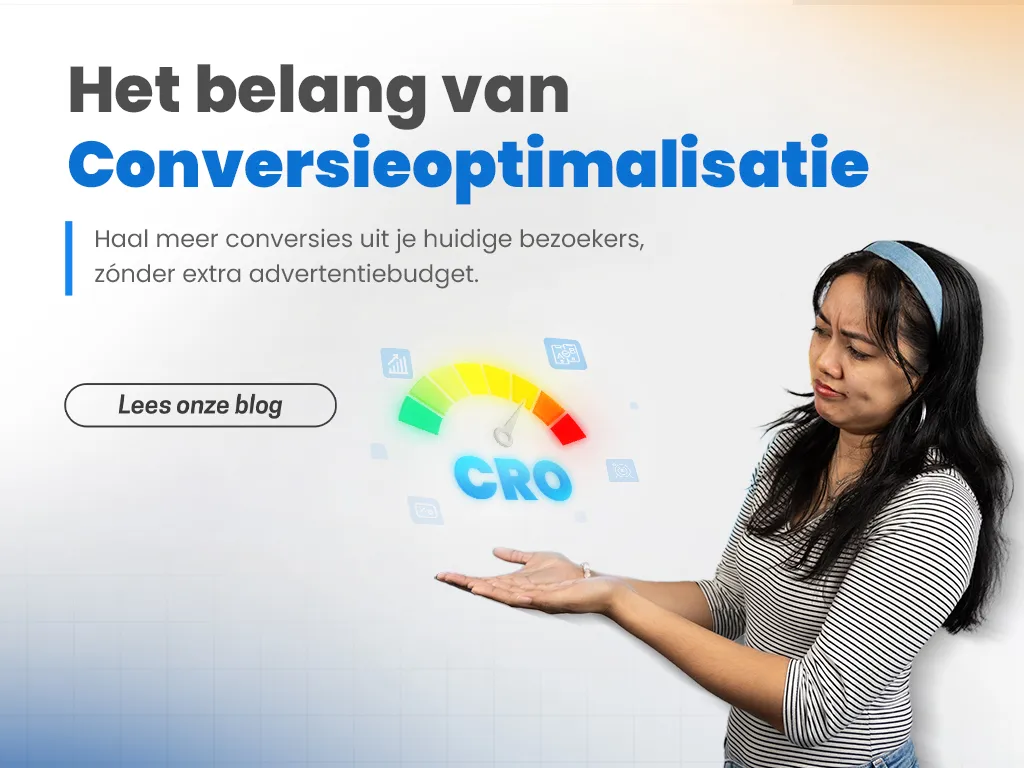
This is the story of many companies that approach us. They invest in Google Ads , they do SEO , they advertise on social media , but somewhere between the click and the conversion, something goes wrong. And that "somewhere" is exactly where conversion optimization (CRO) comes into play.
Because attracting more traffic is one thing. But what if your existing traffic could be worth much more than it currently generates? That is the promise of CRO: not attracting *more* people to your site, but using those who are already there more intelligently. In this blog, we walk through the key principles, common mistakes, and concrete approaches together, including a behind-the-scenes look with our in-house tag specialist.
01 More traffic is not always the answer
Imagine this: you manage a campaign that draws a thousand visitors to your website every month. Great, right? But if only one percent of them convert, you have ten customers. If you increase your conversion rate to three percent without a single extra visitor, you suddenly have thirty customers. Three times the result, for the same budget.
That is the power of CRO. Not a trick, not a quick fix, but a strategic way to extract more value from what you already have. Yet time and again, we see companies instinctively reaching for more advertising budget, while the low-hanging fruit is simply hanging on their own website — unused, waiting to be picked.
💡 The core
Conversion optimization is not an alternative to attracting traffic — it is the multiplier that determines how hard that traffic works for you. Also, check out our other services to see how we handle both sides.
02 The buttons that no one sees, the forms that everyone abandons
Let's start with the basics, because this is where things surprisingly often go wrong. A slow website is very harmful. Not just a little annoying, but very harmful.
Research shows time and again that visitors drop off if a page takes longer than three seconds to load. Three seconds. That is less time than it takes to take a sip of coffee. And if you pay per click, every drop-off literally means wasted money.
✓ Is your call-to-action immediately visible, or do you have to scroll to find it?
✓ Do you only ask in your form for what you really need at this moment?
✓ Does your page work flawlessly on mobile — truly tested, not just in the browser?
✓ Does your visitor know what you offer and what to do within three seconds?
03To measure is to know, but only if you do it right.
This is where it gets interesting. Because to optimize, you first need to understand exactly what is happening on your website. And that is where tracking and tagging play a crucial role. Without proper measurement, you are optimizing in the dark: you make adjustments, but never know if it really makes a difference.
A common mistake: companies measure that someone converts, but not how they arrived at that conversion. Which ad? Which page? Which button? That kind of granular data is the difference between a gut feeling and a well-founded decision. And those decisions ultimately determine where your budget goes.
🔍 TOOLS THAT MAKE THE DIFFERENCE
Use heatmaps and session recordings via tools like Microsoft Clarity. This allows you to literally see where visitors click, how far they scroll, and where they drop off. Combine this with Google Analytics 4 for a complete picture of your conversion funnel — from first click to purchase.
INTERVIEW · TAG SPECIALIST
What does our tag specialist say about conversion measurement?

1. What is your most important advice for companies just starting with conversion tracking?
The most important advice is to start simple and deliberately limit the number of measurement platforms.
In practice, you often see that:
- a web administrator extracts figures from the website,
- a marketer works with Google Analytics 4 and advertising platforms,
- while the entrepreneur looks at yet another dashboard.
Because each platform collects and attributes data in its own way, the figures will never match 100%. It is important to adopt a clear measurement strategy and determine in advance which platform is leading for which KPIs. Keep in mind that different tools measure data differently. For instance, organic traffic in Google Analytics 4 will always differ from Google Search Console.
Additionally, you must accept that data coverage is never fully comprehensive due to privacy legislation (GDPR), cookie banners, and browser restrictions such as Apple's ITP and ad blockers. Although Server-Side Tracking can compensate for some of this data loss, discrepancies will always remain.
2. What is the most common mistake when setting up conversion tracking, and how do you avoid it?
Many companies view conversion tracking as a one-off task. In reality, it is a continuous process closely linked to the dynamics of your website, tracking tools, and marketing platforms. Therefore, the most common mistake is not the technical setup itself, but the lack of communication and subsequent maintenance.
Common situations are:
- Changes to the website or in tracking tools that are not coordinated with the marketer or tracking specialist.
- Changes in legislation or platform terms that impact how data may be collected.
The solution lies in structure and communication:
- Ensure clear documentation of your measurement setup.
- Work with established processes for changes
- Grant access to the tracking tools to only a small, responsible group.
- Periodically check if your measurements are still working correctly.
04A/B testing: stop guessing, start measuring
One of the most effective tools within CRO is the A/B test. You create two versions of a page, version A and version B, and let traffic determine which one works better. It sounds simple, and it is. But the pitfall lies in impatience.
We see it regularly: a test lasts three days, the entrepreneur draws conclusions, and we are back to square one. Statistical significance takes time. Good CRO work does too.
❌ COMMON MISTAKE
Three days of testing and drawing conclusions based on eighty visitors
✓ THE RIGHT APPROACH
Waiting for statistical significance — at least two weeks
✓ Wait for sufficient data before drawing conclusions
✓ Document every test so you learn from what works and what doesn't
✓ Use tools for reliable results
05Trust builds conversions
There is something else that many companies underestimate: the human factor. Visitors are not robots. They hesitate, compare, scroll back, and read reviews. They want to know: can I trust this company? And you don't answer that question with beautiful images alone.
Small things make a big difference. A customer story in the right place. A certificate or quality mark near the order button. A clear privacy policy. Concrete results instead of vague promises. It is the small details, but in conversion optimization, details are everything.
✓ Customer reviews and testimonials, preferably with name and specific result
✓ Logos of well-known clients or partners visible on the page
✓ Quality marks, certifications, or security badges near the form or order step
✓ A clear privacy policy and visible, easily accessible contact information
✓ Case studies or concrete, measurable results that substantiate your promise
06The CTA: small button, big difference
'Click here.' 'More information.' 'Send.' These are CTAs that do nothing. They are so generic that they are almost invisible. A good call-to-action is specific, action-oriented, and gives the visitor a reason to click now. Not tomorrow. Not later. Now!
❌ WEAK
More information
Says nothing, promises nothing, convinces no one
✓ STRONG
Get your free consultation, today
Concrete, valuable, urgent
Also ensure your CTA stands out visually: a contrasting color, sufficient white space around it, and a size that is easy to tap on mobile. One strong CTA in the right place beats ten weak buttons scattered across a page.
07Forms: as few as possible, as smart as possible
If your goal is a form — a quote request, a registration, a contact request — then one golden rule applies: only ask for what you really need at this moment. Every extra field is an extra hurdle. And hurdles cost conversions. Every time.
Do you really need a phone number, company name, and a detailed description during the first point of contact? Or can you suffice with a name, email address, and one short question? You can request additional information later—once you have already made contact and gained trust.
💡 PRO TIP: MULTI-STEP FORMS
Break down long forms into multiple steps. Psychologically, this feels much lighter—the visitor has already 'invested' after step one and is therefore less likely to drop out. The barrier is at the beginning, not halfway through.
08CRO is not a one-off project — it is a mindset
This is perhaps the most important lesson: conversion optimization is never finished. Consumer behavior changes, your offering evolves, and competitors adjust their approach. Those who stand still fall behind. That is not doom-mongering; that is simply how the market works.
The most successful companies treat CRO as an ongoing process: a cycle of measuring, testing, learning, and improving. After a year of a serious CRO approach, you possess a wealth of insights that your competitor does not have, and that gap is difficult to close.
🎯 HOW WE DO IT
At Optimize Digital Marketing, we combine Google Ads with an ongoing CRO approach. Curious what that could mean for you? Contact us for a no-obligation consultation.
What exactly is conversion optimization?
Conversion optimization (CRO) is the process of modifying your website or landing page so that a higher percentage of your visitors take a desired action, such as making a purchase, filling out a form, or contacting you. It is not about attracting more traffic, but about extracting more value from the traffic you already have.
How long does it take to see results?
Smaller adjustments can have an effect within just a few weeks. Structural improvements and A/B tests often require four to eight weeks to generate reliable data. CRO is a long-term strategy, but the ultimate ROI makes that investment more than worthwhile.
Does my company have enough traffic for CRO?
As a rule of thumb, you need at least a few hundred visitors per month to run meaningful tests. Do you have less traffic? Then we first focus on qualitative methods such as user research, heatmaps, and expert reviews to quickly identify the biggest areas for improvement.
What is the difference between CRO and SEO?
SEO focuses on attracting more visitors via search engines. CRO focuses on what happens afterward, once the visitor is on your site. Both are essential and reinforce each other: more relevant traffic and a higher conversion rate give you the best results. It is not an either/or choice, but a both/and strategy.
Can Optimize Digital Marketing help us with both advertising and conversion optimization?
Absolutely! And it is actually a shame to treat those two separately. If you purchase paid traffic via Google Ads but your landing page converts poorly, you are wasting budget. Feel free to contact me for a no-obligation consultation.
Ready to get more out of your existing visitors?
We help you from conversion strategy to optimized landing page — fully customized!