Written by: Aaliyah Lo-A-Njoe | ⏱️Estimated reading time: 11 minutes
Hey Marketing Mavericks,
Remember that moment when you first realized Google wasn't the only player in the search game? When ChatGPT, Claude, and Perplexity suddenly provided answers where users previously had to scroll through ten pages of search results?
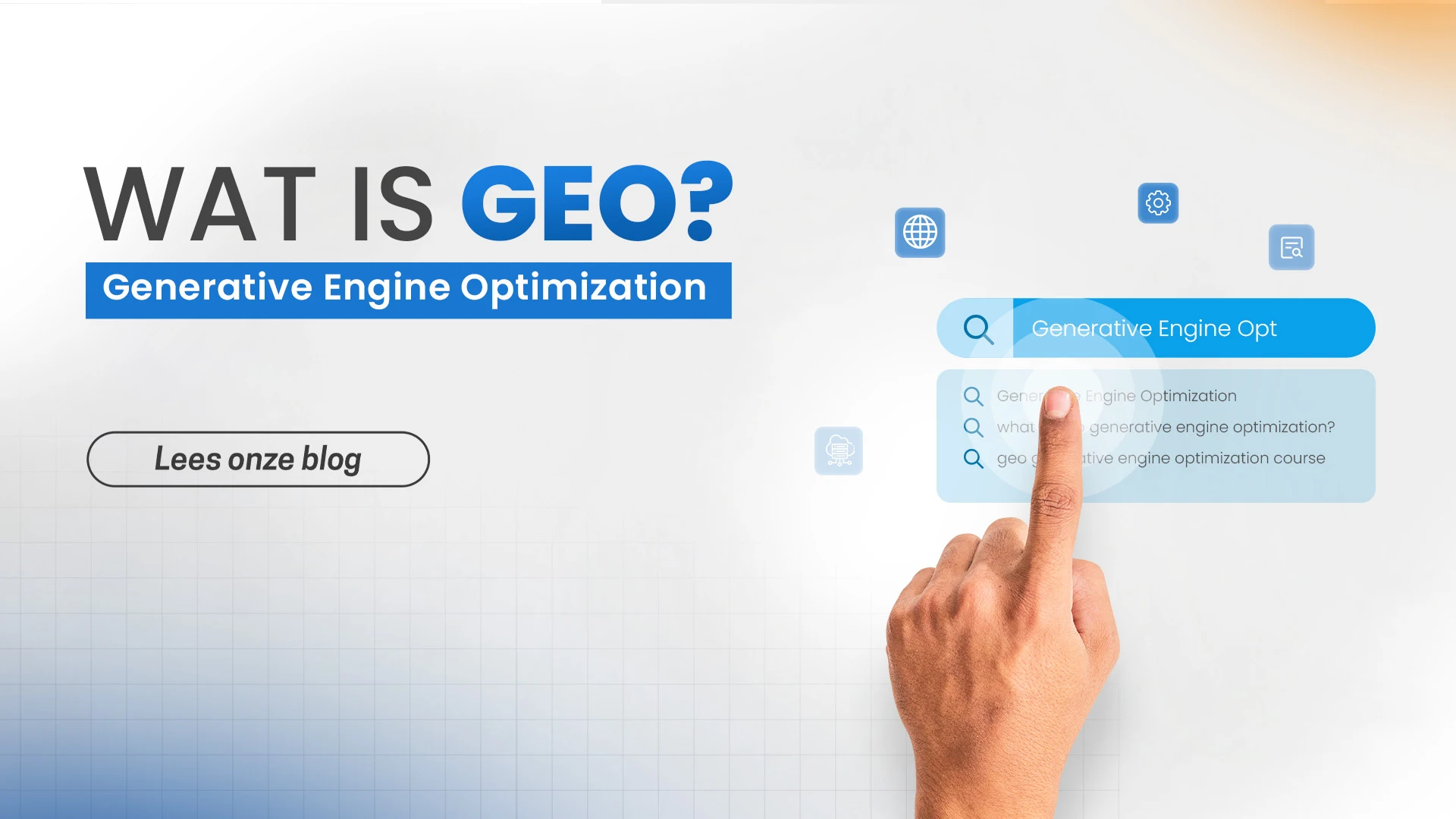
Welcome to the world of Generative Engine Optimization . Or as we call it: the evolution you cannot ignore.
The Big Shift (and Why SEO Isn't Dead)
SEO is not dead. But the landscape? That is changing very fast.
GEO is a paradigm that helps content creators improve their visibility in answers generated by AI engines. While traditional SEO revolves around rankings and backlinks, GEO is about something fundamentally different: being cited by AI models when they generate answers.

Think of the difference between being seen in a shop window versus actually being recommended by a trusted advisor. And guess who that advisor is these days? ChatGPT, Gemini, Claude – the AI engines that increasingly determine search behavior.
What actually makes GEO different?
Here it comes. GEO focuses on optimizing content and website structure so that AI systems understand the broader context, the relationship with your brand, and multiple layers of detail. It is not just about keyword stuffing (that doesn't work anymore, by the way).
The three pillars of successful GEO
- Increase semantic footprint
This means publishing new content and optimizing existing pages to cover broader topic clusters and related topics. Consider the difference between an article about "Instagram marketing" versus a content ecosystem about social media strategies, influencer marketing, content calendars, and analytics.
- Increase fact density
AI models love facts. Hard data. Concrete figures. If you write SEO blogs , fill them with statistics, research, and verifiable information. No vague blather about "many companies" or "studies show." Mention names, figures, and sources.
- Optimizing structured data
Schema markup is no longer optional. It's the language AI engines use to read and understand your content. If your website doesn't have structured data, you're invisible—no matter how good your content is.
The measurable impact
Okay, now it gets interesting. Research from Princeton University, Georgia Tech, and The Allen Institute for AI shows that GEO can increase visibility in generative engine responses by up to 40%. The researchers tested this on a benchmark of no less than 10.000 diverse queries. Forty percent! That’s not just a rounding error in your analytics.
A great example: a global CRM provider that partnered with DEPT® agency improved their visibility by 65% in AI-generated answers. They had strong SEO performance but were completely absent from Google's AI Overviews for the valuable search query "What is a CRM database?" Through content optimization, they went from a 33% to a 55% appearance frequency – an increase of 65%.
Sounds familiar? That is exactly why we at Optimize Digital Marketing no longer talk about either SEO or GEO. It is a matter of both.
The new metrics that matter
Forget your traditional KPIs for a moment. Or rather: keep them, but add these.
New indicators are replacing traditional metrics like click-through rate and first-page ranking, including: Generative appearance score (the frequency and prominence of a source within AI-generated answers), Share of AI voice (the share of AI answers in which a brand is mentioned), and AI citation tracking (monitoring mentions and references within AI-generated text).
The practical approach

This is where many marketers go wrong: they think GEO is some magically complex thing that only data scientists understand. Nonsense.
Start here:
Audit your current citations
Search for your brand in ChatGPT, Claude, Gemini. Are you mentioned? In what context? With which queries? This gives you a baseline.
Identify content gaps
Use AI to generate likely user prompts based on identified clusters. Can your existing pages answer these prompts? Or do you need new content?
Optimize for comprehensiveness
AI favors content that not only answers the user's search query but also anticipates related sub-questions. Think of that friend who always has the perfect answer, including the context you didn't know you needed.
Test, measure, iterate
Just like traditional SEO, GEO isn't a one-size-fits-all strategy. AI algorithms change frequently, and optimizations must be continuously updated.
The intersection of SEO and GEO
GEO doesn't replace SEO; it complements it. And here's why that's important: about 50% of the sources cited in AI Overviews also rank in the top 10 results for that query.
So yes, your traditional SEO fundamentals—technical optimization, quality content, authority building—remain crucial. But now you need to look at them through an additional lens: the lens of AI interpretation.
The challenges (because it's not all roses and moonshine)
Today, the most significant gap exists at the prompt level. Unlike traditional SEO, where keyword rankings and SERP impressions provide visibility, GEO lacks transparency into which queries your content triggers within AI systems.
It's like marketing in the dark. You know your content is being used, but you don't always know when, why, or how often.
But is that a reason to wait? Absolutely not. First-mover advantage is real, especially in a market that's evolving so rapidly.
The future is now

Here's the hard truth: By 2025, generative engine optimization had become a standard part of digital marketing strategies, with many agencies integrating GEO into their SEO workflows.
GEO is no longer optional. It's no longer something for early adopters or tech nerds. It's fundamental to modern digital marketing.
Ask yourself: When was the last time someone on your team tested a query in ChatGPT or Gemini to see if your brand was mentioned? When was the last time you specifically structured your content to be citable for AI models?
The companies investing in GEO now are building their visibility for the coming years. The companies waiting? They'll soon be fighting for the crumbs. Visibility. Authority. Conversions. Whether those come through Google's SERP or ChatGPT's answer – your customers don't care. They just want to find the best answer.
Make sure your brand is that answer.
Frequently Asked Questions about GEO
What is the difference between SEO and GEO?
SEO optimizes for traditional search engines and focuses on rankings, backlinks, and keyword relevance. GEO, on the other hand, optimizes for AI-powered generative engines like ChatGPT and Gemini, where the goal is to be cited in AI-generated answers. The bottom line: SEO ensures your content ranks, GEO ensures your content is selected by AI.
Will GEO replace my existing SEO strategy?
No, absolutely not. GEO complements SEO. Strong SEO foundations even increase your chances of appearing in AI results. About 50% of the sources in AI Overviews also rank in the top 10 of traditional search results. You need both for complete digital visibility in the future.
How do I measure the success of my GEO efforts?
The most important metrics are: Generative Appearance Score (how often you're mentioned in AI answers), Share of AI Voice (your share of total AI mentions in your industry), and AI Citation Tracking (monitoring mentions and the context in which your brand appears). Traditional metrics like CTR are less relevant for GEO.
What content works best for GEO?
AI models favor comprehensive, fact-dense content with structured data. Think of articles that answer not only the main question but also related sub-questions, including concrete statistics, research, and verifiable sources. Content with good schema markup has a significantly higher chance of being cited.
How long does it take to see results from GEO?
GEO isn't a quick fix, but a continuous strategy. Initial improvements in AI citations can be seen within weeks of content optimization, but sustainable results require ongoing testing and iteration. AI algorithms are constantly evolving, so your GEO strategy must evolve accordingly. Companies that invest consistently see an average of 40-65% improvements in AI visibility.
GET MORE RESULTS FROM ONLINE MARKETING?
CONTACT US TODAY AND WE WILL HELP YOU GROW!